Streaming with recovery
Server-Sent Events deliver status, previews and results. Keep-alives, account-scoped request IDs and temporary recovery records help preserve a result when a connection breaks.
Ideas you can see, change and explore.
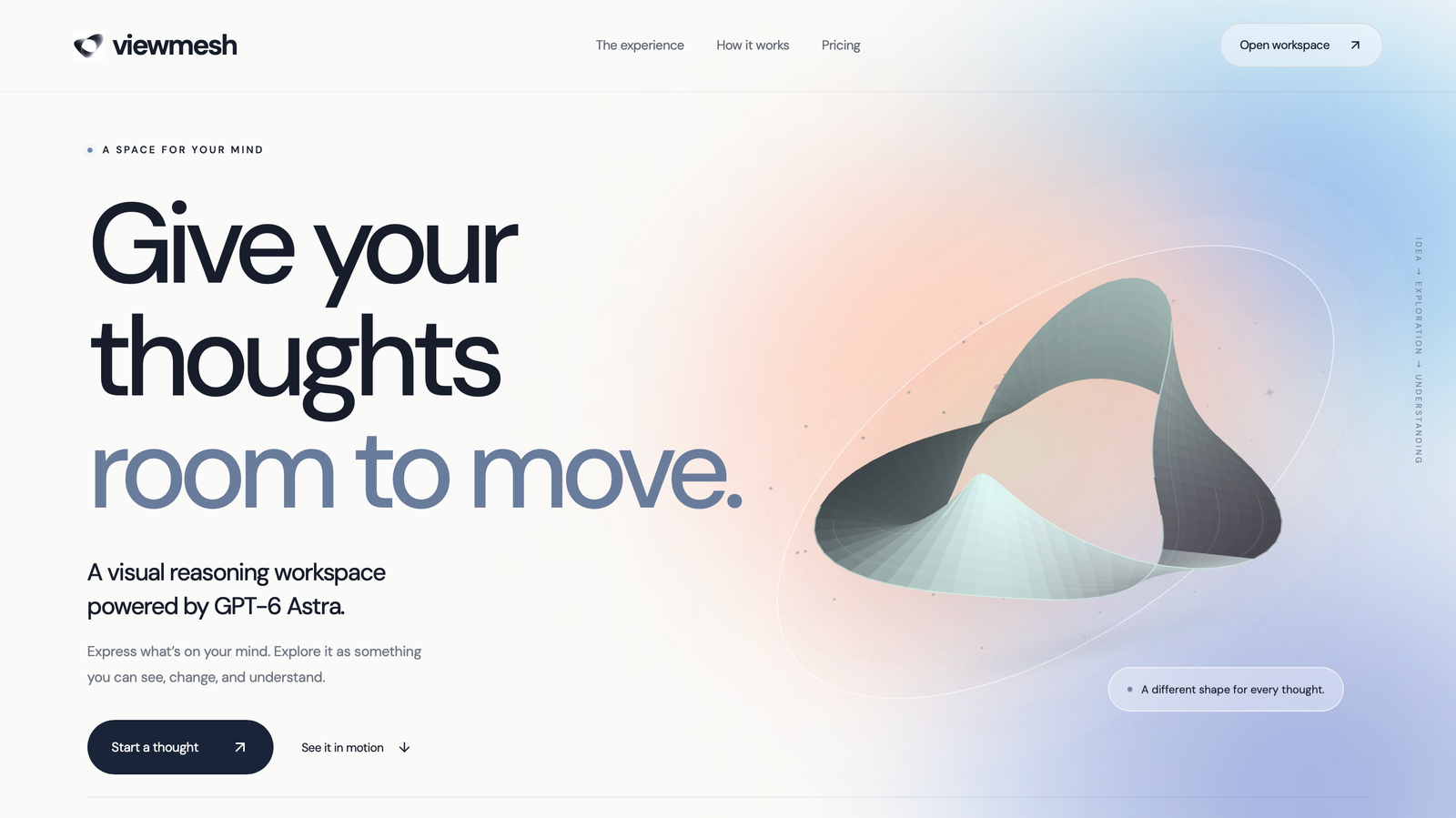
Screenshot of the project website
ViewMesh transforms natural-language questions into interactive visual explanations. GPT-6 Astra generates custom React interfaces, diagrams and procedural 3D scenes that people can manipulate through playback, sliders, selection and follow-up requests.
I designed, architected, built, tested and deployed ViewMesh independently. It is the current evolution of my earlier ViewLane direction.
One Next.js application hosts navigation, history, authentication and purchasing. Server routes handle generation, validation, compilation, usage accounting and recovery. A separate browser runtime renders generated content and talks to the host through a MessageChannel. A custom SDK supplies timelines, path-following particles, camera transitions and spatial annotations.
The prompt, current visualization and recent context
Preview, metadata, initial state and JSX or targeted edits
Structured output and approved imports
React, animation and optional 3D inside an iframe
Playback, sliders, camera and follow-up edits
The details that make the experience or workflow work in practice.
Server-Sent Events deliver status, previews and results. Keep-alives, account-scoped request IDs and temporary recovery records help preserve a result when a connection breaks.
The server validates the model response and compiles against an import allowlist. Generated code runs in a sandboxed iframe with a Content Security Policy blocking network connections and nested frames; it does not execute in the server process.
Playback, scrubbing, parameter changes and camera movement happen in the browser. A follow-up can modify the visualization while retaining user state.
The backend reserves an estimated request cost, then settles against reported usage. Stripe signed webhooks fulfill purchases idempotently; local workspaces support import and export.
Workspaces live in browser localStorage. Private server files hold credit, spending and temporary recovery records, with locking and atomic writes.
GPT-6 Astra through the OpenAI Responses API.
Structured JSON carrying a provisional preview, metadata, initial state and a JSX module or targeted edits.
The request can include the current visualization, saved state and recent conversation, so follow-ups work on the existing artifact.
Validation, compilation boundaries and recovery records protect the path from model output to a usable visual. Post-compilation failures remain an active reliability focus.
Node.js tests, TypeScript checks and production-build verification support release quality.
The thinking behind the architecture and product experience.
Custom React and 3D output leaves room for novel explanations. The import allowlist, iframe, CSP and MessageChannel put a defined boundary around that freedom.
Local playback and manipulation keep exploration responsive and avoid an AI request for every interaction.
Reserving an estimated maximum before the model call keeps free-trial and paid allowances predictable; settlement uses reported usage afterward.
The model can create original code and scenes, which makes visual quality possible but also creates compilation and runtime failure modes. Validation, approved imports and isolated rendering handle the execution boundary. Current work concentrates on generated-code reliability, visual quality and errors that appear after compilation.
Deployed experimental beta. Core generation, rendering, authentication and payment infrastructure is implemented.
Open the live product to explore the current workspace and visual generation flow.
Explore ViewMesh